
How Women Are Leading in the Age of AI
Artificial intelligence is reshaping how organizations operate, how decisions are made and how work itself is defined. Algorithms already recommend products, screen job candidates, write reports and analyze data faster than many human teams. Generative AI systems are now drafting strategy documents, producing marketing content and supporting software development.
March 30, 2026
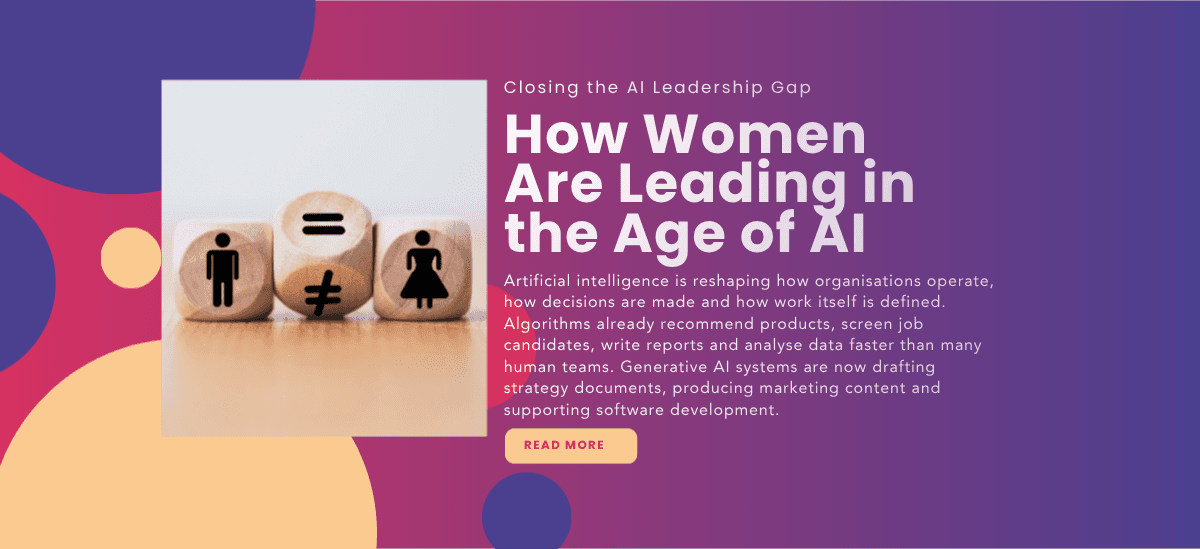
Closing the AI Leadership Gap
Artificial intelligence is reshaping how organizations operate, how decisions are made and how work itself is defined. Algorithms already recommend products, screen job candidates, write reports and analyze data faster than many human teams. Generative AI systems are now drafting strategy documents, producing marketing content and supporting software development. For professionals across every sector, the shift is unmistakable.
Yet in the middle of this transformation, one pattern remains clear: women remain significantly underrepresented in the systems shaping the AI economy. Women currently make up less than one-third of the global AI workforce. In leadership positions, that number drops even further. Only about 15% of senior AI leadership roles are held by women, despite women representing a large share of the global professional workforce.
At the same time, studies show that women adopt AI tools 10–40% less frequently than men.
This gap is not simply a technical issue. It is a leadership issue.
At She Loves Data (SLD), we see this moment as an important turning point. Our mission is to support women in building the competence, confidence and courage needed to thrive in the digital world while making AI skills accessible to women and minorities around the globe.
The question is no longer whether AI will transform industries.
The real question is who will lead that transformation.
The AI transition is already underway
Artificial intelligence is already embedded in daily work across industries.
Banks use machine learning to detect fraud. Healthcare organizations analyze patient data with predictive models. Marketing teams rely on generative AI to accelerate content creation. Governments deploy algorithms to analyze economic trends and public policy outcomes.
AI is rapidly becoming a general-purpose technology, similar to electricity or the internet.
This means the effects is extended far beyond technical professions.
Roles in administration, operations, communications, legal services and finance are already being reshaped by intelligent systems.
According to the International Labour Organisation, 9.6% of traditionally female jobs are likely to be transformed by AI, compared with 3.5% of male jobs.
This does not necessarily mean these jobs will disappear. More often, the tasks inside them change.
However, professionals who understand how these systems work will be far better positioned to adapt.
Let’s explore the barriers and imbalances:
The AI leadership gap
Recent global research highlights the imbalance:
Women represent 22–30% of the AI workforce
Only 12% of AI researchers globally are women
Women hold roughly 26% of specialized AI roles
Only about 15% of AI leadership roles are held by women
Why it matters? When AI systems are designed by a narrow group of people, they risk reflecting the biases and assumptions of that group.
Several well-known examples illustrate the consequences.
Facial recognition systems once misclassified darker-skinned women over 34% of the time while correctly identifying light-skinned men almost perfectly. Hiring algorithms have penalized resumes referencing women’s colleges because the training data reflected historical hiring patterns.
Language models have also shown tendencies to associate women with domestic roles while linking men to leadership and executive positions. These outcomes are not simply technical failures. They are governance failures.
AI systems reflect the perspectives of the people who design them. When leadership is diverse, systems are more balanced and more effective.
The AI adoption gap
The challenge is not only representation in technical roles. There is also a gap in how AI tools are adopted in everyday work.
Across multiple surveys involving more than 140,000 respondents, women consistently report lower levels of generative AI usage than men.
In 2024, approximately:
44% of men reported experimenting with generative AI
33% of women reported the same
Daily use shows a similar pattern.
Research suggests several reasons for this gap.
One factor is trust.
Women report significantly lower trust that AI providers will protect data privacy and security. Only about 18% of women using generative AI report high trust in providers, compared with roughly 31% of men.
Another factor is workplace perception.
Some studies suggest that women worry they may be judged more harshly for using AI tools, particularly in environments where AI use is still viewed as cutting corners rather than enhancing productivity.
These concerns are understandable.
But avoiding AI entirely can create another risk: falling behind in productivity, innovation and influence.
The competence challenge
A third barrier is access to training.
Globally, 63% of women who use AI at work say they lack sufficient training or skills development opportunities.
Without structured learning, many professionals rely on trial and error.
This slows adoption and limits confidence.
At She Loves Data, we believe competence begins with AI literacy.
AI literacy does not require becoming a machine learning engineer. Instead, it means understanding:
how data flows through organizations
how algorithms influence decisions
where bias can emerge in automated systems
how AI tools can be applied responsibly in daily work
This knowledge enables professionals to ask better questions.
And leadership often begins with asking the right questions.
The competence penalty
Even when women adopt AI tools, they sometimes face another barrier.
Research published in Harvard Business Review found that women using AI tools in technical work were rated 9% less competent than men producing identical results.
This phenomenon is often described as the competence penalty.
It creates a difficult paradox.
If women avoid AI tools, they risk being perceived as less innovative.
If they use AI tools, they may face bias in evaluation.
The solution is not avoidance. It is normalization and transparency.
Organizations must recognize that AI is becoming part of professional workflows and adjust evaluation standards accordingly.
The opportunity
Despite these challenges, the momentum is shifting.
Women’s adoption of AI tools is accelerating rapidly. In the United States, generative AI adoption among women more than doubled between 2023 and 2024.
Deloitte predicts that women’s AI usage may reach parity with men.
More importantly, women in senior technical roles are already leading AI adoption within organizations.
This suggests that once access and confidence barriers are addressed, the adoption gap can close quickly.
Communities like She Loves Data play an important role in this shift.
By providing accessible community-based education, mentorship and professional networks, these communities help professionals build the competence and confidence required to engage with AI systems.
What’s next?
Let’s state the obvious fact:
1. Artificial Intelligence will influence every sector of the economy.
2. The professionals who understand these systems will shape the decisions surrounding them.
AI governance affects healthcare outcomes, financial access, hiring decisions, public policy and economic opportunity.
If women remain underrepresented in these systems, the resulting technologies will reflect a limited set of perspectives.
But if more women step forward as leaders in the AI transition, the systems shaping the future will become more balanced, responsible and effective.
It is important to understand that leadership in the AI era does not belong only to engineers. Anyone willing to understand the systems is in a way shaping the world.
Lead the change by staying AI-informed, connect with professionals navigating the same transition, and adopt Never Stop Learning attitude.
The moment to step forward is now.
References
World Economic Forum. (2024). Global Gender Gap Report 2024.
Deloitte. (2024). Women and Generative AI: Understanding the Adoption Gap.
Harvard Business School – Digital Data Design Institute. (2023). Women Are Avoiding AI.
WomenTech Network. (2024). Women in Artificial Intelligence Statistics.
McKinsey & Company. (2024). The State of AI: Global Survey on AI Adoption.
Written by:
She Loves Data Volunteer
How Women Are Leading in the Age of AI
Artificial intelligence is reshaping how organizations operate, how decisions are made and how work itself is defined. Algorithms already recommend products, screen job candidates, write reports and analyze data faster than many human teams. Generative AI systems are now drafting strategy documents, producing marketing content and supporting software development.
March 30, 2026
Closing the AI Leadership Gap
Artificial intelligence is reshaping how organizations operate, how decisions are made and how work itself is defined. Algorithms already recommend products, screen job candidates, write reports and analyze data faster than many human teams. Generative AI systems are now drafting strategy documents, producing marketing content and supporting software development. For professionals across every sector, the shift is unmistakable.
Yet in the middle of this transformation, one pattern remains clear: women remain significantly underrepresented in the systems shaping the AI economy. Women currently make up less than one-third of the global AI workforce. In leadership positions, that number drops even further. Only about 15% of senior AI leadership roles are held by women, despite women representing a large share of the global professional workforce.
At the same time, studies show that women adopt AI tools 10–40% less frequently than men.
This gap is not simply a technical issue. It is a leadership issue.
At She Loves Data (SLD), we see this moment as an important turning point. Our mission is to support women in building the competence, confidence and courage needed to thrive in the digital world while making AI skills accessible to women and minorities around the globe.
The question is no longer whether AI will transform industries.
The real question is who will lead that transformation.
The AI transition is already underway
Artificial intelligence is already embedded in daily work across industries.
Banks use machine learning to detect fraud. Healthcare organizations analyze patient data with predictive models. Marketing teams rely on generative AI to accelerate content creation. Governments deploy algorithms to analyze economic trends and public policy outcomes.
AI is rapidly becoming a general-purpose technology, similar to electricity or the internet.
This means the effects is extended far beyond technical professions.
Roles in administration, operations, communications, legal services and finance are already being reshaped by intelligent systems.
According to the International Labour Organisation, 9.6% of traditionally female jobs are likely to be transformed by AI, compared with 3.5% of male jobs.
This does not necessarily mean these jobs will disappear. More often, the tasks inside them change.
However, professionals who understand how these systems work will be far better positioned to adapt.
Let’s explore the barriers and imbalances:
The AI leadership gap
Recent global research highlights the imbalance:
Women represent 22–30% of the AI workforce
Only 12% of AI researchers globally are women
Women hold roughly 26% of specialized AI roles
Only about 15% of AI leadership roles are held by women
Why it matters? When AI systems are designed by a narrow group of people, they risk reflecting the biases and assumptions of that group.
Several well-known examples illustrate the consequences.
Facial recognition systems once misclassified darker-skinned women over 34% of the time while correctly identifying light-skinned men almost perfectly. Hiring algorithms have penalized resumes referencing women’s colleges because the training data reflected historical hiring patterns.
Language models have also shown tendencies to associate women with domestic roles while linking men to leadership and executive positions. These outcomes are not simply technical failures. They are governance failures.
AI systems reflect the perspectives of the people who design them. When leadership is diverse, systems are more balanced and more effective.
The AI adoption gap
The challenge is not only representation in technical roles. There is also a gap in how AI tools are adopted in everyday work.
Across multiple surveys involving more than 140,000 respondents, women consistently report lower levels of generative AI usage than men.
In 2024, approximately:
44% of men reported experimenting with generative AI
33% of women reported the same
Daily use shows a similar pattern.
Research suggests several reasons for this gap.
One factor is trust.
Women report significantly lower trust that AI providers will protect data privacy and security. Only about 18% of women using generative AI report high trust in providers, compared with roughly 31% of men.
Another factor is workplace perception.
Some studies suggest that women worry they may be judged more harshly for using AI tools, particularly in environments where AI use is still viewed as cutting corners rather than enhancing productivity.
These concerns are understandable.
But avoiding AI entirely can create another risk: falling behind in productivity, innovation and influence.
The competence challenge
A third barrier is access to training.
Globally, 63% of women who use AI at work say they lack sufficient training or skills development opportunities.
Without structured learning, many professionals rely on trial and error.
This slows adoption and limits confidence.
At She Loves Data, we believe competence begins with AI literacy.
AI literacy does not require becoming a machine learning engineer. Instead, it means understanding:
how data flows through organizations
how algorithms influence decisions
where bias can emerge in automated systems
how AI tools can be applied responsibly in daily work
This knowledge enables professionals to ask better questions.
And leadership often begins with asking the right questions.
The competence penalty
Even when women adopt AI tools, they sometimes face another barrier.
Research published in Harvard Business Review found that women using AI tools in technical work were rated 9% less competent than men producing identical results.
This phenomenon is often described as the competence penalty.
It creates a difficult paradox.
If women avoid AI tools, they risk being perceived as less innovative.
If they use AI tools, they may face bias in evaluation.
The solution is not avoidance. It is normalization and transparency.
Organizations must recognize that AI is becoming part of professional workflows and adjust evaluation standards accordingly.
The opportunity
Despite these challenges, the momentum is shifting.
Women’s adoption of AI tools is accelerating rapidly. In the United States, generative AI adoption among women more than doubled between 2023 and 2024.
Deloitte predicts that women’s AI usage may reach parity with men.
More importantly, women in senior technical roles are already leading AI adoption within organizations.
This suggests that once access and confidence barriers are addressed, the adoption gap can close quickly.
Communities like She Loves Data play an important role in this shift.
By providing accessible community-based education, mentorship and professional networks, these communities help professionals build the competence and confidence required to engage with AI systems.
What’s next?
Let’s state the obvious fact:
1. Artificial Intelligence will influence every sector of the economy.
2. The professionals who understand these systems will shape the decisions surrounding them.
AI governance affects healthcare outcomes, financial access, hiring decisions, public policy and economic opportunity.
If women remain underrepresented in these systems, the resulting technologies will reflect a limited set of perspectives.
But if more women step forward as leaders in the AI transition, the systems shaping the future will become more balanced, responsible and effective.
It is important to understand that leadership in the AI era does not belong only to engineers. Anyone willing to understand the systems is in a way shaping the world.
Lead the change by staying AI-informed, connect with professionals navigating the same transition, and adopt Never Stop Learning attitude.
The moment to step forward is now.
References
World Economic Forum. (2024). Global Gender Gap Report 2024.
Deloitte. (2024). Women and Generative AI: Understanding the Adoption Gap.
Harvard Business School – Digital Data Design Institute. (2023). Women Are Avoiding AI.
WomenTech Network. (2024). Women in Artificial Intelligence Statistics.
McKinsey & Company. (2024). The State of AI: Global Survey on AI Adoption.
Written by:
She Loves Data Volunteer
Closing the AI Leadership Gap
Artificial intelligence is reshaping how organizations operate, how decisions are made and how work itself is defined. Algorithms already recommend products, screen job candidates, write reports and analyze data faster than many human teams. Generative AI systems are now drafting strategy documents, producing marketing content and supporting software development. For professionals across every sector, the shift is unmistakable.
Yet in the middle of this transformation, one pattern remains clear: women remain significantly underrepresented in the systems shaping the AI economy. Women currently make up less than one-third of the global AI workforce. In leadership positions, that number drops even further. Only about 15% of senior AI leadership roles are held by women, despite women representing a large share of the global professional workforce.
At the same time, studies show that women adopt AI tools 10–40% less frequently than men.
This gap is not simply a technical issue. It is a leadership issue.
At She Loves Data (SLD), we see this moment as an important turning point. Our mission is to support women in building the competence, confidence and courage needed to thrive in the digital world while making AI skills accessible to women and minorities around the globe.
The question is no longer whether AI will transform industries.
The real question is who will lead that transformation.
The AI transition is already underway
Artificial intelligence is already embedded in daily work across industries.
Banks use machine learning to detect fraud. Healthcare organizations analyze patient data with predictive models. Marketing teams rely on generative AI to accelerate content creation. Governments deploy algorithms to analyze economic trends and public policy outcomes.
AI is rapidly becoming a general-purpose technology, similar to electricity or the internet.
This means the effects is extended far beyond technical professions.
Roles in administration, operations, communications, legal services and finance are already being reshaped by intelligent systems.
According to the International Labour Organisation, 9.6% of traditionally female jobs are likely to be transformed by AI, compared with 3.5% of male jobs.
This does not necessarily mean these jobs will disappear. More often, the tasks inside them change.
However, professionals who understand how these systems work will be far better positioned to adapt.
Let’s explore the barriers and imbalances:
The AI leadership gap
Recent global research highlights the imbalance:
Women represent 22–30% of the AI workforce
Only 12% of AI researchers globally are women
Women hold roughly 26% of specialized AI roles
Only about 15% of AI leadership roles are held by women
Why it matters? When AI systems are designed by a narrow group of people, they risk reflecting the biases and assumptions of that group.
Several well-known examples illustrate the consequences.
Facial recognition systems once misclassified darker-skinned women over 34% of the time while correctly identifying light-skinned men almost perfectly. Hiring algorithms have penalized resumes referencing women’s colleges because the training data reflected historical hiring patterns.
Language models have also shown tendencies to associate women with domestic roles while linking men to leadership and executive positions. These outcomes are not simply technical failures. They are governance failures.
AI systems reflect the perspectives of the people who design them. When leadership is diverse, systems are more balanced and more effective.
The AI adoption gap
The challenge is not only representation in technical roles. There is also a gap in how AI tools are adopted in everyday work.
Across multiple surveys involving more than 140,000 respondents, women consistently report lower levels of generative AI usage than men.
In 2024, approximately:
44% of men reported experimenting with generative AI
33% of women reported the same
Daily use shows a similar pattern.
Research suggests several reasons for this gap.
One factor is trust.
Women report significantly lower trust that AI providers will protect data privacy and security. Only about 18% of women using generative AI report high trust in providers, compared with roughly 31% of men.
Another factor is workplace perception.
Some studies suggest that women worry they may be judged more harshly for using AI tools, particularly in environments where AI use is still viewed as cutting corners rather than enhancing productivity.
These concerns are understandable.
But avoiding AI entirely can create another risk: falling behind in productivity, innovation and influence.
The competence challenge
A third barrier is access to training.
Globally, 63% of women who use AI at work say they lack sufficient training or skills development opportunities.
Without structured learning, many professionals rely on trial and error.
This slows adoption and limits confidence.
At She Loves Data, we believe competence begins with AI literacy.
AI literacy does not require becoming a machine learning engineer. Instead, it means understanding:
how data flows through organizations
how algorithms influence decisions
where bias can emerge in automated systems
how AI tools can be applied responsibly in daily work
This knowledge enables professionals to ask better questions.
And leadership often begins with asking the right questions.
The competence penalty
Even when women adopt AI tools, they sometimes face another barrier.
Research published in Harvard Business Review found that women using AI tools in technical work were rated 9% less competent than men producing identical results.
This phenomenon is often described as the competence penalty.
It creates a difficult paradox.
If women avoid AI tools, they risk being perceived as less innovative.
If they use AI tools, they may face bias in evaluation.
The solution is not avoidance. It is normalization and transparency.
Organizations must recognize that AI is becoming part of professional workflows and adjust evaluation standards accordingly.
The opportunity
Despite these challenges, the momentum is shifting.
Women’s adoption of AI tools is accelerating rapidly. In the United States, generative AI adoption among women more than doubled between 2023 and 2024.
Deloitte predicts that women’s AI usage may reach parity with men.
More importantly, women in senior technical roles are already leading AI adoption within organizations.
This suggests that once access and confidence barriers are addressed, the adoption gap can close quickly.
Communities like She Loves Data play an important role in this shift.
By providing accessible community-based education, mentorship and professional networks, these communities help professionals build the competence and confidence required to engage with AI systems.
What’s next?
Let’s state the obvious fact:
1. Artificial Intelligence will influence every sector of the economy.
2. The professionals who understand these systems will shape the decisions surrounding them.
AI governance affects healthcare outcomes, financial access, hiring decisions, public policy and economic opportunity.
If women remain underrepresented in these systems, the resulting technologies will reflect a limited set of perspectives.
But if more women step forward as leaders in the AI transition, the systems shaping the future will become more balanced, responsible and effective.
It is important to understand that leadership in the AI era does not belong only to engineers. Anyone willing to understand the systems is in a way shaping the world.
Lead the change by staying AI-informed, connect with professionals navigating the same transition, and adopt Never Stop Learning attitude.
The moment to step forward is now.
References
World Economic Forum. (2024). Global Gender Gap Report 2024.
Deloitte. (2024). Women and Generative AI: Understanding the Adoption Gap.
Harvard Business School – Digital Data Design Institute. (2023). Women Are Avoiding AI.
WomenTech Network. (2024). Women in Artificial Intelligence Statistics.
McKinsey & Company. (2024). The State of AI: Global Survey on AI Adoption.
Written by:
She Loves Data Volunteer

